Underground oil tank, cistern and pit detection
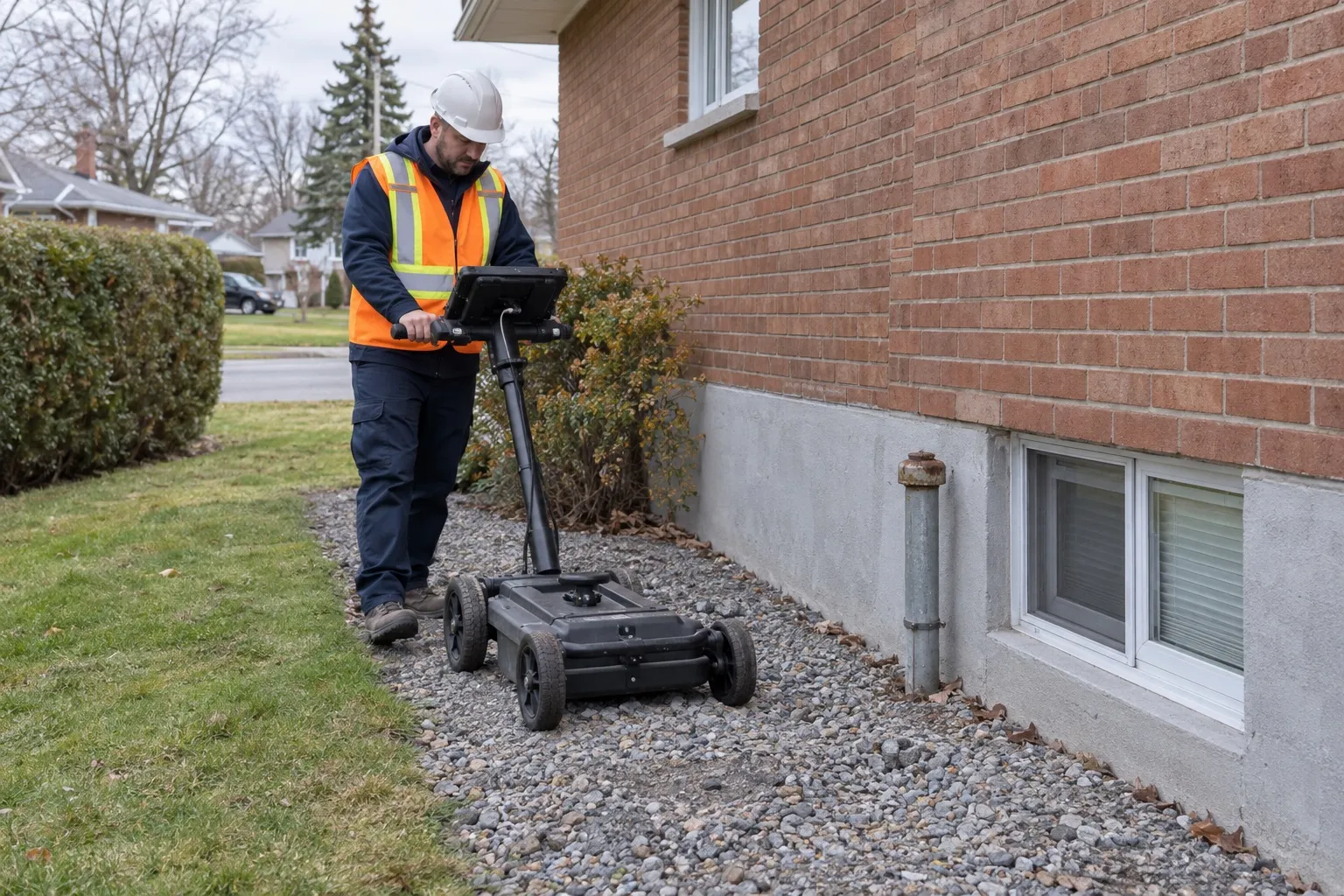
Underground tank detection uses ground penetrating radar to locate oil tanks, cisterns, septic tanks and other buried metal or concrete structures on a property, with their position, approximate dimensions and depth. Détection Souterraine Québec performs this search with GSSI ground penetrating radar and radio detection, then provides a PDF report useful for a real estate transaction, a tank removal or an excavation.
- PDF report within 24 hours
- Submit your Info-Excavation request for public utilities, and entrust us with the private utilities on your property.
At a glance
- Residential and commercial oil tanks
- Cisterns, septic tanks, dry wells and old structures
- Position, estimated dimensions and depth to the top
- PDF report within 24 hours, useful for the buyer, the insurer or the removal contractor
- Montreal, Laval, South Shore, Châteauguay, Dorval
Why search for a buried tank
Thousands of homes in Quebec were heated with oil from a buried tank. After conversion to gas or electricity, the tank was often left in place, sometimes with residual oil. An undeclared tank can complicate a sale, an insurance claim, financing or an excavation.
| Situation | What locating makes possible |
|---|---|
| Buying or selling an older property | Confirm whether a tank is present or absent before the transaction |
| Home insurance application | Document the property with a report |
| Excavation, pool, addition | Avoid puncturing a tank with the excavator |
| Tank removal | Give the contractor the exact position and depth |
| Abandoned septic tank or well | Locate the structure before work or connection to the sewer |
Use cases and scope of the search
A pre-transaction search aims to document the outdoor area of the property where a tank may have been installed. Before a pool, an addition, a trench or a removal, the sweep instead helps the contractor position the work and plan the job. Visible clues, the building's history and the accessible area guide the search grid, but the absence of surface clues is not enough to rule out a buried structure.
For an excavation, also start with Info-Excavation for public utilities. That request does not automatically locate private installations on the property, such as a tank, a line between the house and a piece of equipment, or a pit. Our survey covers the area surveyed and does not replace the Info-Excavation request or the checks required for removal and soil characterization.
Limits of detection
Ground penetrating radar picks up a difference between the structure and the soil, but on its own it cannot determine the condition, tightness or contents of a tank. Roots, fill, asphalt, nearby structures and wet soil can make interpretation less clear. The report states the area swept, the targets consistent with a tank and the uncertainties observed. A confirmation excavation or a characterization by a qualified professional may be required before any removal decision.
How we work
- Surface clues: fill pipe, vent, line trench toward the basement, ground depression, old burner.
- Ground penetrating radar sweep of the likely area, with a tight grid around the clues. A tank produces a characteristic reflection on the profile.
- Radio detection to confirm the metal oil line between the tank and the house.
- Marking and report: tank outline painted on the ground, estimated depth to the top, approximate dimensions and photos.
What the report contains
- The site plan with the position of the tank
- Annotated ground penetrating radar profiles
- The estimated depth to the top and approximate dimensions
- Other structures detected in the area
- A clear statement if no tank was detected in the area covered
Why choose Détection Souterraine Québec
- GSSI ground penetrating radar suited to searching for metal and concrete structures.
- A report a non-specialist can read, accepted by the parties to a transaction.
- Search for other utilities during the same visit to prepare the removal.
- Reply within 24 to 48 business hours, useful when a closing date is approaching.
Related services
Underground utility locating, ground penetrating radar locating and underground conduit locating.
Frequently asked questions
How much does underground tank detection cost? Underground tank detection on a residential property is usually done in a single visit of a few hours. The price depends on the area to sweep and on obstacles (asphalt, landscaping). Request a quote with the address.
Can you confirm there is no tank? Yes, the report specifies the area covered and states that no structure consistent with a tank was detected there. The conclusion is limited to the area swept.
Do you remove the tank? No. We locate it and document its position for the contractor who will carry out the removal and, if needed, the soil characterization.
Do you also detect fibreglass tanks? Ground penetrating radar detects the contrast between the tank and the soil, which also works for non-metallic tanks, with a reliability that depends on the soil and depth.
Verifiable key points
The regulatory framework for a buried tank
A tank that is no longer in use is still a regulated structure. Knowing who regulates what helps prepare a sale, a removal or an excavation.
The RBQ oversees petroleum equipment installations(1)
Since April 2007, the Régie du bâtiment du Québec has been responsible for the regulations governing petroleum equipment installations and their enforcement. The framework is set out in Chapter VIII of the Construction Code and Chapter VI of the Safety Code, both titled “Petroleum Equipment Installation”.
A tank abandoned in place is still covered(2)
The damage prevention standard also covers infrastructure that is out of service or abandoned in place. A tank left in the ground after a change of heating system is therefore part of the search before an excavation.
Yellow, the colour of petroleum products(3)
Yellow designates gasoline, oil, steam, petroleum, gas and other hazardous liquid or gaseous materials. It is the colour used for marking when the target located is a tank or its piping.
Sources
- (1) Régie du bâtiment du Québec, “Lois et règlements” (laws and regulations, in French), petroleum equipment https://www.rbq.gouv.qc.ca/domaines-dintervention/equipements-petroliers/reglementation/lois-et-reglements/
- (2) CAN/CSA-Z247, Damage prevention for the protection of underground infrastructure https://scc-ccn.ca/standards/notices-of-intent/csa-group/damage-prevention-protection-underground-infrastructure
- (3) Canadian guidelines for safe excavation near Bell infrastructure, 2018 (French version, document hosted by Info-Excavation) https://www.info-ex.com/wp-content/uploads/2018/03/2018-Canadian-Excavation-Guidelines_FR_V2.pdf
Resources on this service
All resourcesBuried oil tank: what to check before buying or selling
A house once heated with oil may still hide a buried tank. Here are the signs to look for, what a survey can establish and what it cannot.
Private utilities or Info-Excavation, who locates what?
Info-Excavation covers public utilities up to the property line. Here is what to do about cables, drains and tanks located on your property.
Schedule your underground tank detection
Give us the address, the year of construction if known and the reason for the search. Reply within 24 to 48 business hours.
- PDF report within 24 hours
- Submit your Info-Excavation request for public utilities, and entrust us with the private utilities on your property.