Concrete scanning with ground penetrating radar before core drilling, drilling or saw cutting
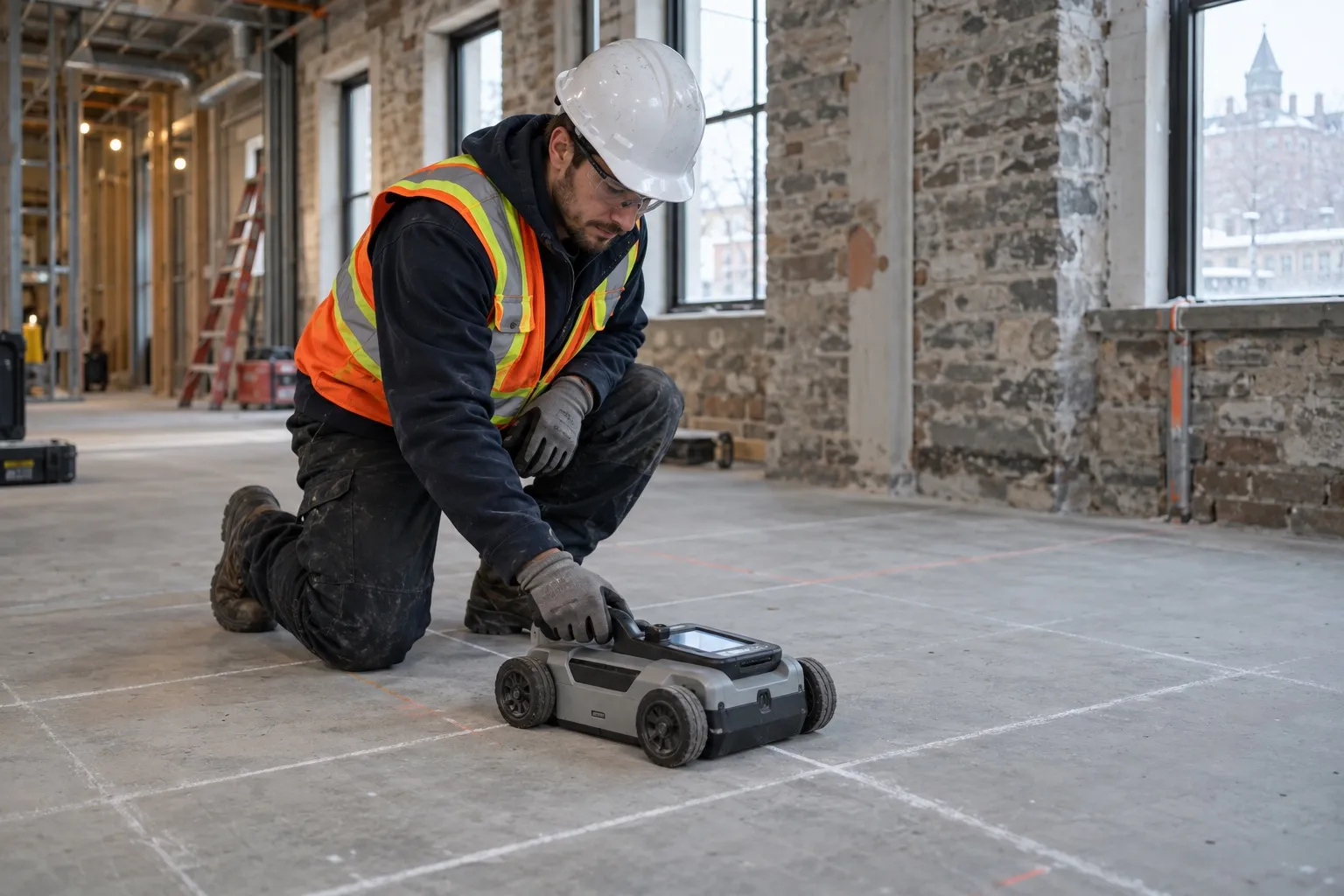
Concrete scanning with ground penetrating radar locates rebar, electrical conduits, post-tension cables, voids and the thickness of slabs, walls and beams without damaging the structure. Détection Souterraine Québec performs the inspection with a GSSI StructureScan, marks the elements directly on the concrete and delivers a PDF report with plans and profiles within 24 hours.
- PDF report within 24 hours
- Submit your Info-Excavation request for public utilities, and entrust us with the private utilities on your property.
At a glance
- Rebar, wire mesh, conduits, post-tension, voids, thickness
- Marking directly on the surface to be drilled
- Real-time results on the job site, PDF report within 24 hours
- Slabs, floors, walls, beams, foundations
- Montreal, Laval, South Shore, Châteauguay, Dorval
What concrete scanning locates
| Element | Risk if drilled | Detection |
|---|---|---|
| Rebar and wire mesh | Structural weakening, broken drill bit | Yes, position and depth |
| Electrical conduits | Electrocution, power outage, fire | Yes, metal and PVC |
| Post-tension cables | Sudden cable failure, major damage | Yes, top priority |
| Radiant heating tubes | Leak in the slab | Yes, depending on material |
| Voids under slab | Settlement | Yes |
| Slab thickness | Wrong choice of anchor | Yes |
When to scan concrete
- Before core drilling for plumbing, ventilation or a cable pass-through
- Before chemical or mechanical anchors in a slab or a wall
- Before saw cutting an opening in a slab or a load-bearing wall
- Before installing radiant flooring or new systems
- To assess the condition of a slab (voids, deterioration) before repair
Use cases on a job site
A targeted scan is suitable when the crew already knows the core drilling, anchoring or saw cutting locations. A grid sweep is more appropriate when several openings are planned or when the available plans do not reflect the actual condition of the structure. Marking is done on the surface concerned so that the areas to avoid remain visible while the work is being prepared.
Concrete scanning applies to the structure being inspected, inside or around the building. It does not replace an Info-Excavation request for an outdoor excavation and does not, on its own, locate all private utilities on the property. For conduits and service connections in the ground, the work area must be assessed with the appropriate underground locating methods.
How we work
- Cleaning and identifying the area to be drilled with your crew.
- Grid sweep with the StructureScan, with real-time reading.
- Marking rebar, conduits and post-tension on the concrete, with the safe zone for drilling.
- PDF report with plan, profiles and recommendations.
Capabilities and limits
Scan quality depends on the density of the concrete, its moisture and the presence of steel fibres. Very dense or saturated concrete reduces the reading depth. We choose the antenna frequency according to the thickness and flag in the report any area where the reading is uncertain. The scan is an inspection: it maps the interior, and it does not replace an engineer's opinion on structural capacity.
The scan cannot certify the strength or load-bearing capacity of a slab, wall or beam. Closely spaced elements, irregular surfaces and inaccessible areas can also limit interpretation. The report distinguishes the elements observed from the areas where the reading is uncertain; the drilling method and the structural decision remain the responsibility of the site crew and the engineer when required.
Why choose Détection Souterraine Québec
- GSSI StructureScan designed for concrete inspection.
- On-site marking: your crew can drill as soon as we leave.
- Report within 24 hours for the project file or the engineer.
- Underground locating and concrete scanning by the same team when the project involves both the ground and the slab.
Related services
Ground penetrating radar locating for outdoor surveys, underground utility locating and underground conduit locating.
Frequently asked questions
How much does concrete scanning cost? The price of concrete scanning depends on the number of areas to be drilled and their accessibility. A few core drilling locations can be scanned in less than half a day. Request a quote with the number of openings and the address.
Does concrete scanning damage the slab? No. Ground penetrating radar is non-destructive; no drilling or coring is needed for the inspection.
Can you tell the difference between rebar and a conduit? In most cases, yes, thanks to the shape and depth of the reflections and to radio detection of energized conduits. Ambiguous cases are flagged in the report.
What is the turnaround for a job site emergency? We prioritize requests where a crew is waiting to drill. Write "job site emergency" in your request or call us.
Verifiable key points
Preparing the slab and knowing the limits of the survey
Data quality depends as much on the condition of the surface as on the equipment. These points come from the service page mock-up provided for the site.
Preparing the surface before the visit(1)
Cleaning the surface, marking the areas of interest and pointing out wet areas or thick coverings improves the quality of the data collected. Clear access also makes it possible to scan in a grid rather than in isolated passes.
What reduces wave penetration(1)
The limits of the survey depend mainly on the composition of the material, its thickness and the presence of water. In very dense concrete, high-density reinforced concrete or concrete containing steel fibres, wave penetration can be reduced.
An inspection, not a structural diagnosis(1)
Concrete scanning provides a map of the inside of the structure. It replaces neither a visual inspection nor a laboratory analysis, and its results are meant to be interpreted by a professional.
Sources
- (1) Service page mock-up provided for the site, “Préparation et limites” (preparation and limits) texts (figma-reference/FIGMA-CONTENU.md)
Resources on this service
All resourcesConcrete scanning before core drilling: what you need to know
Drilling a slab without knowing what is inside is costly. Here is what a concrete scan locates, how it works and the limits to know before coring.
Coring, drilling, boring: the sequence that keeps utilities intact
A slab, a trench or piles do not carry the same risk. Here is the order of checks before opening up, and what to do when there is uncertainty.
Schedule your concrete scan
Send us the number of areas, the type of structure and the address. Reply within 24 to 48 business hours.
- PDF report within 24 hours
- Submit your Info-Excavation request for public utilities, and entrust us with the private utilities on your property.