About Détection Souterraine Québec
Knowing what lies beneath your work, before you start.
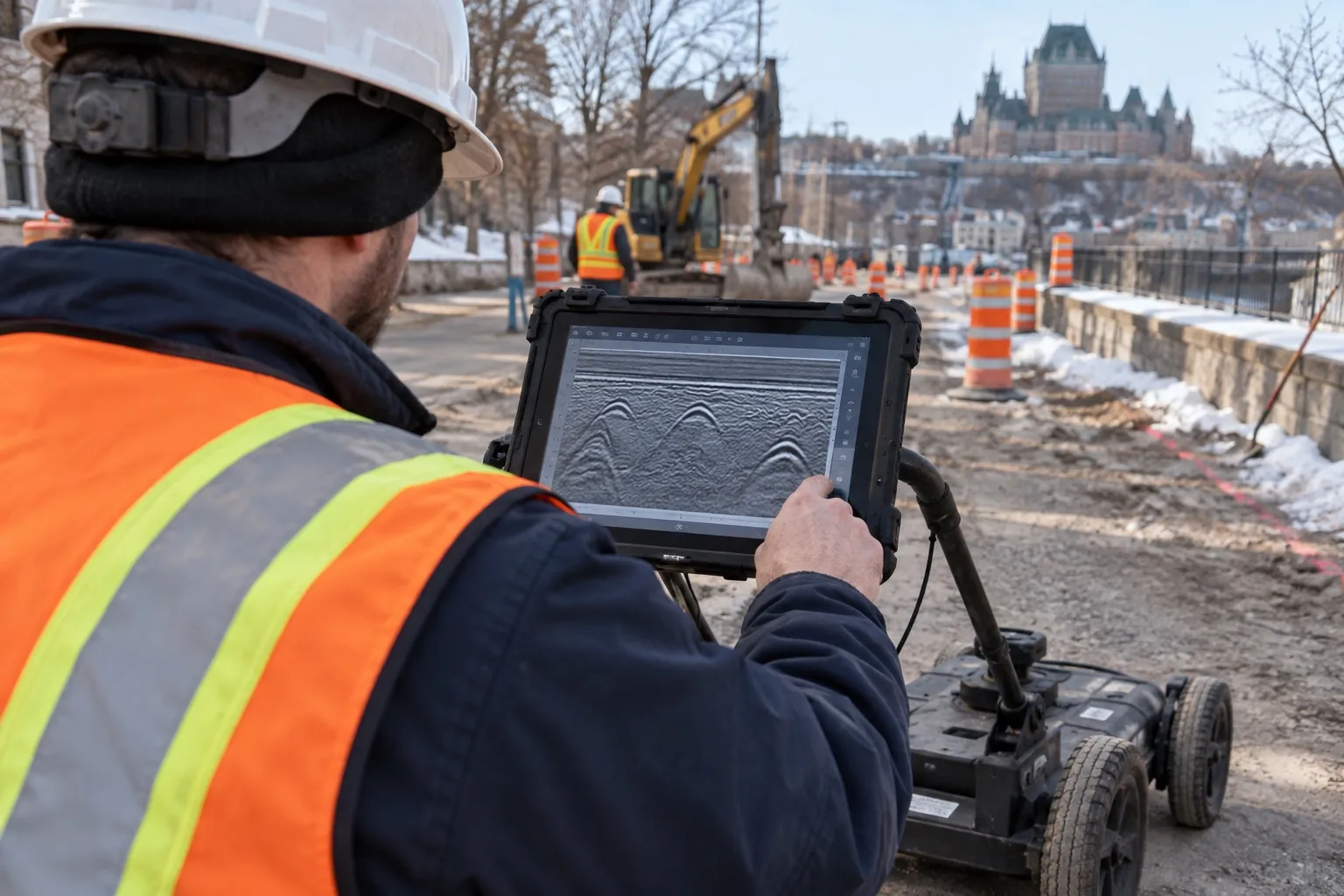
A forgotten pipe, an unmarked cable or an old tank can complicate a project. At Détection Souterraine Québec, we help contractors and property owners better understand what lies beneath their property and inside their concrete before they dig, drill or saw.
Our work: locate buried elements and give you clear information to prepare your work.
We serve Montreal, Laval, the South Shore, Châteauguay and Dorval.
Useful information for the people doing the work
On a job site, you need to be able to use the locating results to make concrete decisions: adjust a trench route, prepare a core drilling, find a pipe or plan the removal of a tank.
We approach each job based on your work, the characteristics of the site and the elements being sought. We also take into account available plans, access points and obstacles that may affect the survey.
The goal is to give you an understandable reading of the inspected area, with the observations and limitations needed to prepare the work.
Expertise for soil and concrete
We handle a range of locating needs:
- Underground infrastructure: locating utilities and buried structures in the work area.
- Pipes and lines: locating water lines, drainage lines and other buried conduits.
- Underground cables: locating electrical and telecommunications cables.
- Buried tanks: locating heating oil tanks, cisterns and other buried structures.
- Concrete scanning: locating rebar, conduits and other elements before drilling, core drilling or sawing.
Methods adapted to site conditions
Ground penetrating radar and radio detection provide complementary information. The choice of methods depends in particular on the material being sought, the depth, the soil and the available access.
We adapt our approach to these conditions and cross-check observations when possible. Clay soil, a hard-to-access utility or a heavily reinforced slab can limit the reading: these constraints must be part of the information provided to the client.
A depth indication remains an estimate. An uncertain area must be flagged. This transparency helps you plan the checks and precautions needed during the work.
What you can expect from our team
A good understanding of your project
Before the job, we seek to understand what you are preparing, what you need to find and the decisions the survey must help you make.
Understandable results
The marking and survey information must be useful to your crew, your excavator, your plumber or the professionals working with you.
Direct communication
We explain what was observed, what remains uncertain and the limits of the inspected area. You can then prepare the next steps with more complete information.
For contractors and property owners alike
We work with excavation and construction companies, property managers, building professionals and residential property owners.
Whether you are preparing a pool, a fence, an addition, a commercial renovation or work on a pipe, the first step is the same: understand your project to target the right locating.
Verifiable key points before your project
Info-Excavation and private utilities
- Info-Excavation locates public utilities free of charge up to your property line.
- Service connections and private utilities on your property must be located by a private service like ours.
- We check that the Info-Excavation request has been made for the public portion.
GSSI ground penetrating radar and radio detection
- The technician combines GSSI ground penetrating radar and electromagnetic radio detection to cover both metallic and non-metallic utilities.
- GSSI equipment (UtilityScan for the ground, StructureScan for concrete).
- GSSI StructureScan designed for concrete inspection.
Ground marking and PDF report
- Utilities are marked on the ground according to the colour code in effect, then you receive a PDF report with a plan, estimated depths and recommendations.
- The PDF report follows within 24 hours after the survey.
- You receive a PDF with the location plan, the ground penetrating radar profiles, the estimated depths and the areas of uncertainty.
Two technologies on every job
- The technician scans the area with ground penetrating radar, then traces metallic utilities by radio detection by connecting to access points (meters, manholes, boxes).
- Two technologies on every job: ground penetrating radar and radio detection complement each other, and neither is enough on its own.
- Each utility is marked on the ground with the corresponding colour and depth markers.
Where we work
- Détection Souterraine Québec works on the Island of Montreal, in Laval, on the South Shore, in the Châteauguay region and on the West Island around Dorval.
- Our technicians adapt the method to the site and deliver the same PDF report within 24 hours everywhere.
- We plan travel according to the scope of the assignment.
Our commitments, and their limits
- The quote is free and with no obligation.
- We reply within 24 to 48 business hours and schedule the job according to the urgency of your site.
- The results describe the area swept, the targets observed and the uncertainties noted on site. They are not a guaranteed plan of all utilities, nor an authorization to excavate.
Let's talk about what you need to locate
Tell us the city, the planned work and the elements you are looking for. If you have a plan or photos of the site, attach them to your request to help us prepare the job.
- PDF report within 24 hours
- Submit your Info-Excavation request for public utilities, and entrust us with the private utilities on your property.