Water line and buried pipe locating
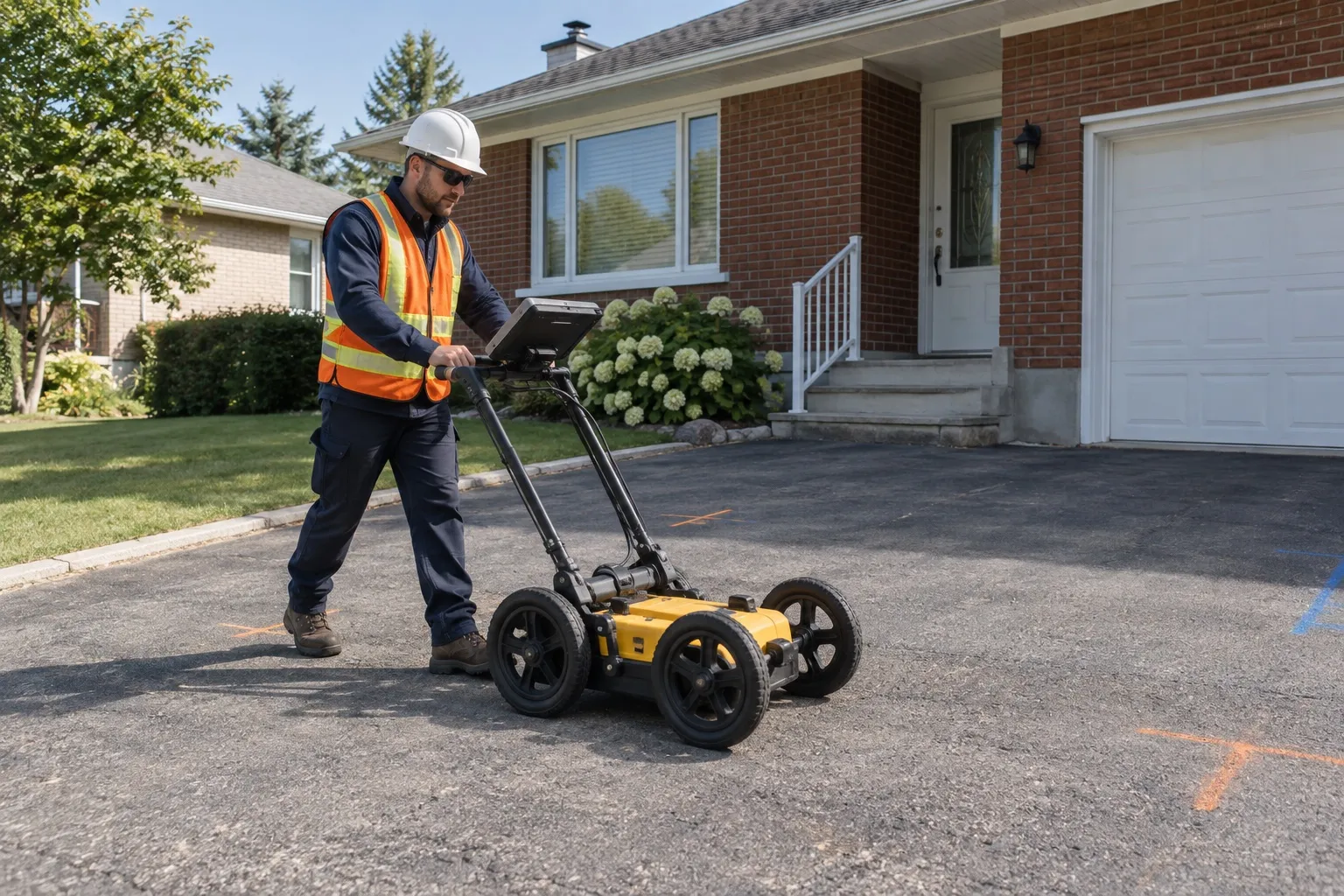
Water line locating identifies the path and depth of the water service line, private water main, irrigation pipes or any buried pipe before a replacement, a repair or excavation work nearby. Détection Souterraine Québec traces copper, cast iron and steel lines with radio detection, and locates PVC or HDPE pipes with GSSI ground penetrating radar or a sonde.
- PDF report within 24 hours
- Submit your Info-Excavation request for public utilities, and entrust us with the private utilities on your property.
At a glance
- Residential and commercial water service lines
- Private water mains, irrigation, abandoned pipes
- Metallic and plastic pipes
- Blue ground marking and PDF plan with depths
- Montreal, Laval, South Shore, Châteauguay, Dorval
When to locate a water line
| Situation | What locating helps you avoid |
|---|---|
| Replacing a lead or copper water service line | Digging in the wrong place and opening the service twice |
| Suspected leak under the property | Excavating without knowing where the pipe runs |
| Connecting a new building or a pool | Puncturing the existing water main |
| Buying a property without plans | Finding an abandoned pipe in the middle of an excavation |
| Landscaping work with machinery | A broken line and a job site shutdown |
Our method by material
- Copper, cast iron, steel: the signal is injected on the pipe at the building entry or at the valve, then followed on the surface to the street. Depth is read at each marker.
- PVC, HDPE, polyethylene: located with ground penetrating radar or, if the pipe is accessible and empty, with a transmitting sonde.
- Abandoned pipe or no access: ground penetrating radar sweep of the presumed area.
In the report, we specify the method used for each segment and the confidence level of the depth.
What you receive
- The path marked on the ground in blue, with depth markers
- A PDF plan of the path, ready for your plumber, your excavator or the City
- Areas of uncertainty flagged, with a recommendation for hand digging or hydro-excavation
Why choose Détection Souterraine Québec
- Metal and plastic covered with two technologies.
- Report within 24 hours, useful to obtain an excavation permit or coordinate with the City.
- Reply within 24 to 48 business hours, with urgent visits possible when the water is shut off.
- Locating of other utilities during the same visit if your trench crosses electrical, gas or telecom lines.
Related services
Underground conduit locating and underground utility locating for a complete survey.
Frequently asked questions
How much does water line locating cost? Water line locating for a home, from the building entry to the street, is usually done in a few hours. The price depends on the length, the material and access to the connection points. Request a quote for your address.
Can you locate a buried plastic pipe? Yes. Ground penetrating radar detects PVC and HDPE pipes depending on the soil and depth; a sonde can also be inserted into an accessible pipe that is out of service.
Do you detect leaks? Our service locates the path and depth of the pipe. For a leak, precise locating of the path lets your plumber target testing and excavation in the right place.
Is the path accurate enough to excavate? The horizontal position is accurate to within a few centimetres. The depth is an estimate to be confirmed by hand digging or hydro-excavation when approaching the pipe.
Verifiable key points
Preparing the locate request before the work
A water service line is rarely replaced in a rush. The locate request timelines and the colour code help schedule the job at the right time.
Four business days before work begins(1)
The Régie du bâtiment du Québec asks that the locate request be submitted at least 4 business days before work begins. Private locating is scheduled in the same window, so that the public and private portions are marked together.
A request valid for up to 180 days(1)
The request remains valid until the end-of-work date entered on it, for a maximum of 180 days. A project postponed beyond that date requires a new request, and often new marking.
Blue for drinking water, green for sewers(2)
Blue designates drinking water and green designates sewer and drain lines. On a property where the two cross, the distinction avoids opening the wrong trench.
Sources
- (1) Régie du bâtiment du Québec, “Travaux d’excavation” (excavation work, in French) https://www.rbq.gouv.qc.ca/vous-etes/entrepreneur/travaux-dexcavation/
- (2) Canadian guidelines for safe excavation near Bell infrastructure, 2018 (French version, document hosted by Info-Excavation) https://www.info-ex.com/wp-content/uploads/2018/03/2018-Canadian-Excavation-Guidelines_FR_V2.pdf
A client’s story
“They located my lead water service line in under an hour. Fast and accurate, I recommend them!” (translated from French)
Client, Montreal · Lead water service line
Resources on this service
All resourcesNon-invasive water leak detection in Quebec without digging
Learn how non-invasive water leak detection locates your water line without digging and targets the repair in the right spot, without damage.
Info excavation Quebec for digging safely in the capital
Learn how to combine info excavation Quebec with a private GPR survey to dig safely despite shallow bedrock and aging utilities in Quebec City.
Schedule your water line locating
Give us the address, the type of building and the reason for the work. Reply within 24 to 48 business hours.
- PDF report within 24 hours
- Submit your Info-Excavation request for public utilities, and entrust us with the private utilities on your property.