Underground electrical and telecom cable locating
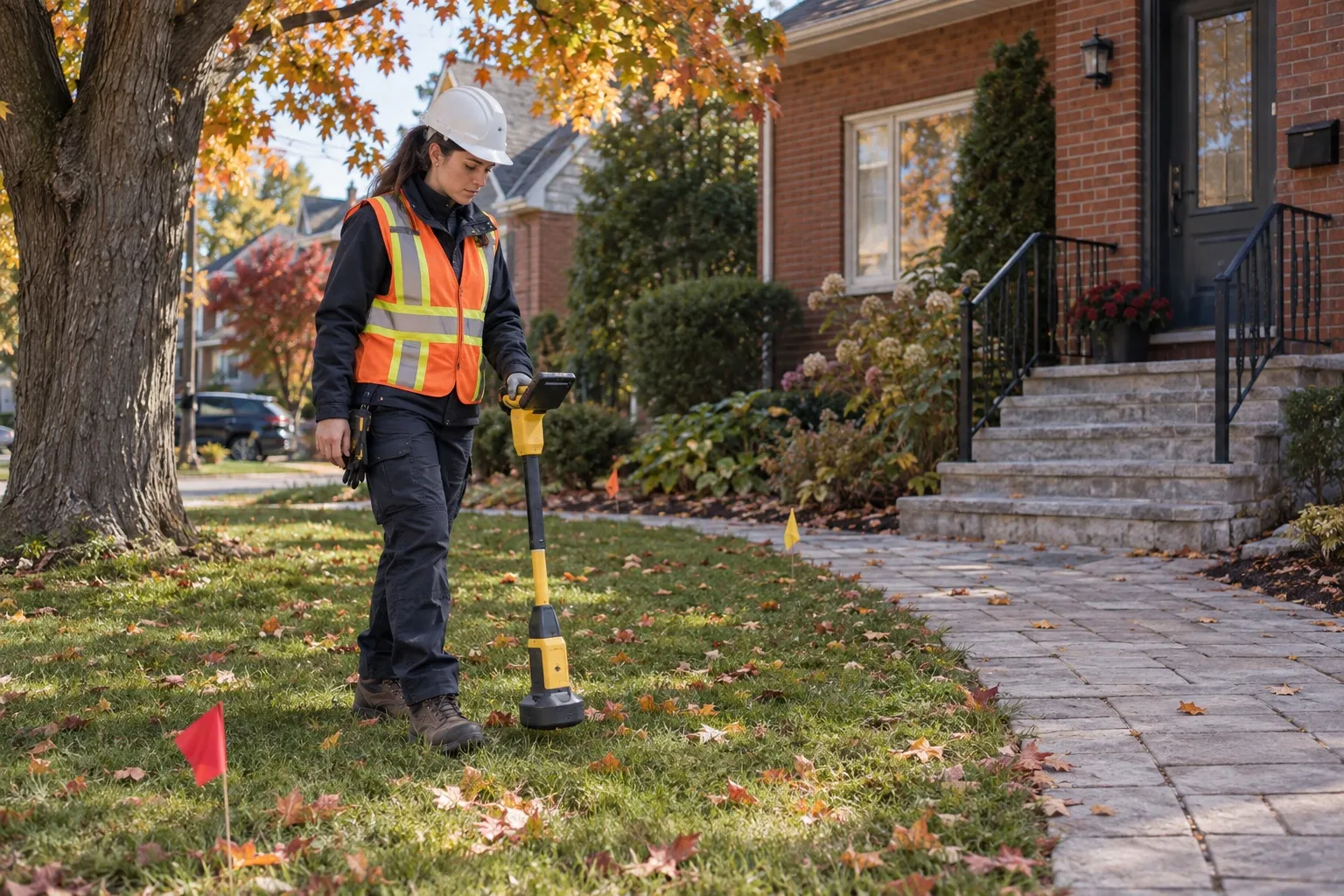
Underground cable locating identifies the path and depth of buried electrical and telecommunication cables on private property: power feeds to a garage, shed, pool, light pole, pump or second building, and fibre and cable between buildings. Détection Souterraine Québec traces these cables with electromagnetic radio detection and supplements with GSSI ground penetrating radar for non-metallic ducts.
- PDF report within 24 hours
- Submit your Info-Excavation request for public utilities, and entrust us with the private utilities on your property.
At a glance
- Low and medium voltage electrical cables, lighting, telecom, fibre
- Locating in active mode (injected signal) and passive mode (energized cable)
- Red (electrical) and orange (telecom) marking with depths
- PDF report within 24 hours
- Montreal, Laval, South Shore, Châteauguay, Dorval
Cables covered
| Cable | Example | Locating mode |
|---|---|---|
| Secondary power feed | House to garage, shed, pool | Active or passive |
| Outdoor lighting | Parking lot light poles, landscape lighting | Active |
| Private medium voltage | Campus, plant, shopping centre | Passive, and active at an access point |
| Telecom and fibre | Link between buildings, service entrance | Active on metallic duct or sonde |
| Abandoned cable | Old installation with no power | Ground penetrating radar |
A de-energized cable in a plastic duct gives off no signal. We energize it with the transmitter or locate it with ground penetrating radar.
Why locate before you dig
A cable cut by an excavator bucket or an auger exposes the operator to electric shock and cuts power to the building. On a job site, that means a work stoppage, a repair by a master electrician and sometimes an inspection. A few hours of locating avoids this risk.
Typical situations
- Installing a fence, posts or helical piles
- Planting trees or mechanized landscaping
- Excavating for a pool, a spa or a deck
- Adding an accessory building with electrical power
- Resurfacing a lit parking lot
How we work
- Passive sweep of the area to detect energized cables.
- Signal injection from the panel, junction box or light fixture to trace each cable individually.
- Ground penetrating radar on suspect sections with no electromagnetic response.
- Ground marking and PDF plan with depths.
Why choose Détection Souterraine Québec
- Active and passive locating so an undocumented energized cable is not missed.
- Ground penetrating radar as a complement for plastic ducts and dead cables.
- Depth at every marker, essential for piles and augers.
- Locating of other utilities during the same visit if needed.
Related services
Underground conduit locating and underground utility locating.
Frequently asked questions
How much does underground cable locating cost? Underground cable locating on a residential property usually takes a few hours. The price depends on the number of cables, the area to cover and access to the panels. Request a quote with your address and the planned work.
Can you locate a de-energized cable? Yes, by injecting a signal with the transmitter if a connection point is accessible, otherwise with ground penetrating radar.
How deep are buried cables? It varies with the installation. The report gives the estimated depth at each marker; we recommend hand digging when approaching the marked path.
Do you locate Hydro-Québec cables? Public utilities up to the property line fall under Info-Excavation. We locate private cables, from the connection point to the equipment.
Verifiable key points
Marking and safety distance around a cable
Ground marking follows a standardized colour code, and the distance to keep around the path is set before the first shovelful.
Red for electricity, orange for communications(1)
Red designates electrical installations, lines, conduits and lighting cables. Orange designates communications, meaning transmission, alarm and signal lines, cables or conduits. An unexpected colour on private property usually points to a utility that no one has declared.
A one-metre buffer zone on each side(1)
The buffer zone is a strip one metre wide on each side of the underground infrastructure marking. It frames the area that mechanical equipment must not enter without precaution.
Hand exposure before mechanical equipment(1)
Within this zone, infrastructure is exposed by hand before mechanical excavation equipment is used. The marking and the estimated depth serve precisely to know where to start this exposure.
Sources
- (1) Canadian guidelines for safe excavation near Bell infrastructure, 2018 (French version, document hosted by Info-Excavation) https://www.info-ex.com/wp-content/uploads/2018/03/2018-Canadian-Excavation-Guidelines_FR_V2.pdf
Resources on this service
All resourcesPrivate utilities or Info-Excavation, who locates what?
Info-Excavation covers public utilities up to the property line. Here is what to do about cables, drains and tanks located on your property.
Schedule your underground cable locating
Tell us which cables you are looking for and what work you are planning. Reply within 24 to 48 business hours.
- PDF report within 24 hours
- Submit your Info-Excavation request for public utilities, and entrust us with the private utilities on your property.