How an underground utility locating job works
From the quote request to the delivery of the report, here is what happens at each step, the equipment used, the timelines and what the PDF report contains. Every item on this page restates what is already described on our service pages.
- PDF report within 24 hours
- Submit your Info-Excavation request for public utilities, and entrust us with the private utilities on your property.
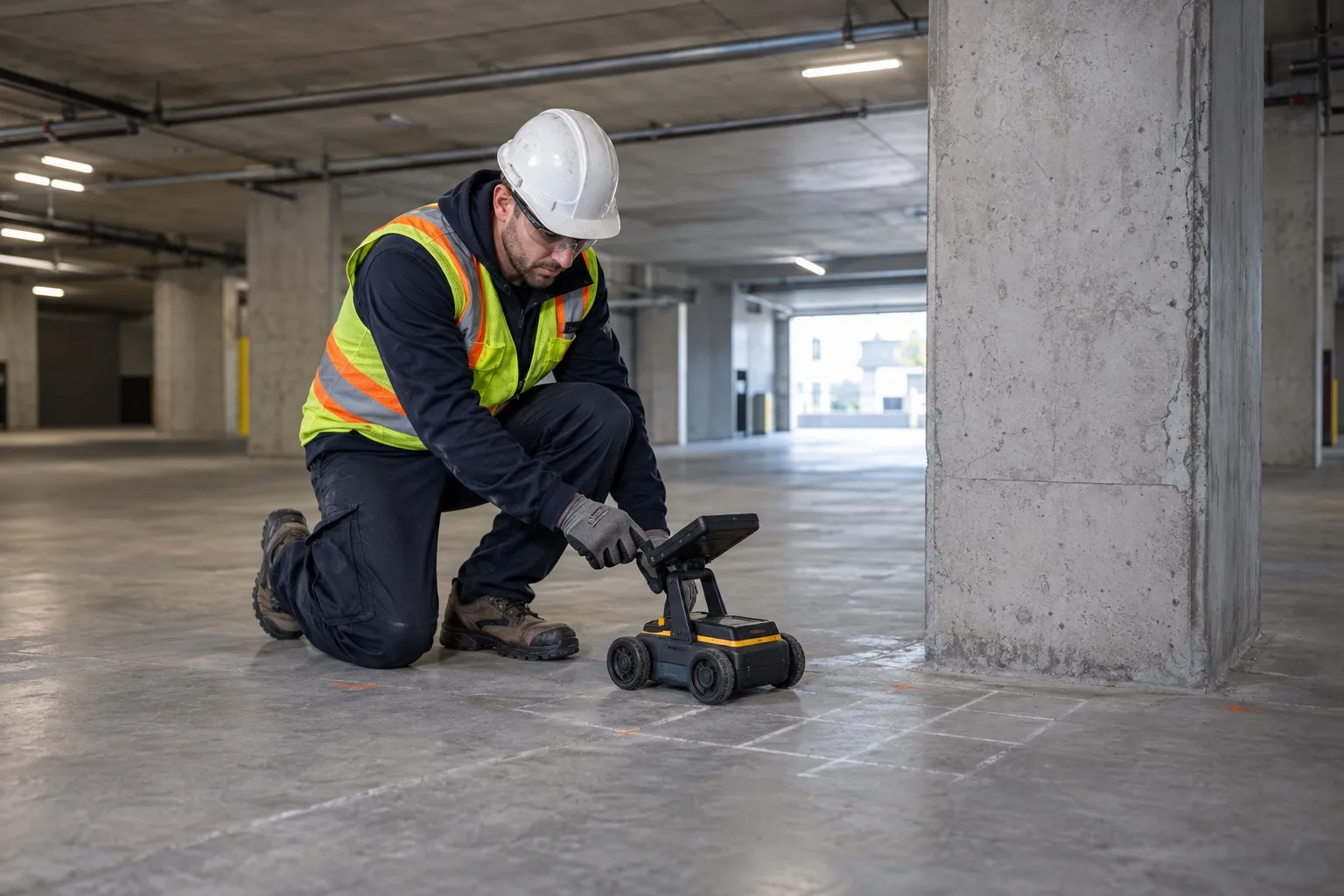
From request to report
- Your request. We review your request and call you back if a detail is missing.
- The quote. You receive a quote with the method, the estimated duration and the price.
- The job date. We set the job date according to your schedule.
- Preparation. You send us the area to cover, the planned work and any existing plans. We check that the Info-Excavation request has been made for the public portion.
- On-site locating. The technician scans the area with ground penetrating radar, then traces metallic utilities by radio detection by connecting to access points (meters, manholes, boxes).
- Marking. Each utility is marked on the ground with the corresponding colour and depth markers.
- The report. You receive a PDF with the location plan, the ground penetrating radar profiles, the estimated depths and the areas of uncertainty.
Equipment used
| Equipment | What it does |
|---|---|
| GSSI UtilityScan ground penetrating radar | Locates plastic and concrete conduits and buried structures in the ground |
| GSSI StructureScan ground penetrating radar | Inspects concrete: rebar, conduits, post-tension cables, voids and thickness |
| Electromagnetic radio detection | Traces metallic utilities that are live or accessible through a connection point |
Two technologies on every job: ground penetrating radar and radio detection complement each other, and neither is enough on its own. Plastic or concrete conduits without a tracer wire do not respond to radio detection: that is where ground penetrating radar makes the difference.
Timelines
We reply within 24 to 48 business hours and schedule the job according to the urgency of your site. The PDF report follows within 24 hours after the survey. Site emergencies are handled as a priority.
What the report contains
- The location plan of the utilities found
- The ground penetrating radar profiles
- The estimated depths and the areas of uncertainty
- A clear legend, ready for your site crew or your engineer
The report states the reliability of each depth. The horizontal position of marked utilities is generally accurate to within a few centimetres. Depth is an estimate that depends on the soil; the report shows the areas of uncertainty and recommends hand digging or hydro excavation near the utilities.
Colour code for ground markings
| Colour | Utility |
|---|---|
| Red | Electricity |
| Yellow | Gas, oil, steam |
| Orange | Telecommunications, cable TV |
| Blue | Drinking water |
| Green | Sewers, drainage |
| Purple | Reclaimed water, irrigation |
| Pink | Temporary survey markings |
| White | Proposed excavation limits |
What we ask you to prepare
Info-Excavation locates public utilities free of charge up to your property line. Everything on the private side (service connections, site conduits, cables between buildings, tanks, old foundations) is not covered. That is exactly what we locate. Send us the area to cover, the planned work and any existing plans.
Frequently asked questions
What is your response time? We reply within 24 to 48 business hours and schedule the job according to the urgency of your site. The PDF report follows within 24 hours after the survey.
Is Info-Excavation enough before digging? No. Info-Excavation covers public utilities up to the property line. Service connections and private utilities on your property must be located by a private service like ours.
How deep can ground penetrating radar see? Radio detection follows a metallic conduit several metres deep. Ground penetrating radar generally reaches one to three metres in Quebec soils, less in saturated clay. The report states the reliability of each depth.
Do you also work in concrete? Yes. Our concrete scanning service locates rebar, conduits and post-tension cables before core drilling, drilling or sawing, with a GSSI StructureScan.
Resources on this service
All resourcesInfo excavation Quebec for digging safely in the capital
Learn how to combine info excavation Quebec with a private GPR survey to dig safely despite shallow bedrock and aging utilities in Quebec City.
Info-Excavation Montreal for locating utilities before digging
Learn how Info-Excavation Montreal works, which utilities are covered or not, and the steps to locate your pipes before digging on the island.
Ready to schedule your locate?
Send us the city, the type of work and the schedule, and we will get back to you within 24 to 48 business hours.
- PDF report within 24 hours
- Submit your Info-Excavation request for public utilities, and entrust us with the private utilities on your property.