Info-Excavation Montreal is the free locate request to submit before any job on the island. This organization notifies its member owners of public utilities, who mark their infrastructure up to the property line. Private utilities, however, require additional specialized locating before digging.
Digging in Montreal is unlike any other job site in Quebec, and that is exactly why the Info-Excavation Montreal process deserves your full attention. Beneath downtown streets as well as residential lots in Rosemont or Ahuntsic lies a tangle of water, gas, electrical and telecommunications lines, some of them a century old.
A single misplaced shovelful can cut power to an area, cause a dangerous leak or derail a tight schedule. The good news is that prevention relies on clear, accessible steps. This guide explains the process, what it really covers and what still escapes your radar.
Why Info-Excavation Montreal changes everything in such a dense subsurface
The big difference between a Montreal job site and one in the regions lies in the concentration of infrastructure. On the island, several generations of utilities are layered in a limited subsurface, sometimes only a few centimetres below the surface.
In the central neighbourhoods, water mains sit alongside fibre optics, power cables and old installations whose plans have sometimes disappeared. This accumulation makes the slightest error far more consequential than elsewhere.
That is why an underground locating service in Montreal relies on both the official process and precise field surveys. Density leaves no room for improvisation: it turns a simple locate into a critical step in any excavation project.
What Info-Excavation Montreal covers and what it leaves out
The organization is the only damage prevention centre in Quebec. It brings together the major utility owners and forwards your request to those with installations in your work area. You can submit a free locate request online, at any time.
The key point is simple: the process covers the members' public utilities, but only up to your property line. Anything buried afterward on the property remains outside the official picture.
Understanding this boundary is essential. To go further, this article details how to distinguish private utilities from public ones and avoid the most common blind spots on a Montreal property.
- Municipal water and sewer : Water service line after the meter
- Natural gas (Énergir) : Garden lighting and outlets
- Electricity (Hydro-Québec) : Power to a shed or garage
- Telecommunications (Bell, cable companies) : Buried oil tank, weeping tile
How to make a locate request step by step
The procedure is faster than you might think. The most important thing is to start it early enough and wait for all responses before beginning. Under the Régie du bâtiment's excavation obligations, the request must be submitted at least four business days before work begins and remains valid for up to one hundred and eighty days.
Here are the main steps to follow:
The three-step request process clearly shows how good preparation avoids unpleasant surprises. For a broader overview, this guide also explains how to locate infrastructure before digging anywhere in Quebec.
Before you take out the shovel, have everything lying under your property mapped. In addition to the Info-Excavation Montreal process, a professional subsurface survey reveals the private utilities that no one else will flag. Plan this locating from the design stage and dig with peace of mind.
- Mark out your work area precisely on the map, because this sketch determines which members will be notified.
- Submit the request online, free of charge, at least four business days in advance.
- Wait for a response from each owner concerned before digging.
- Check whether private utilities on your property need to be located separately.
Private utilities the public process does not detect
This is where most residential and commercial incidents happen. Once past the property line, no one notifies members anymore: private installations become your responsibility.
Among the elements most often overlooked on a Montreal property:
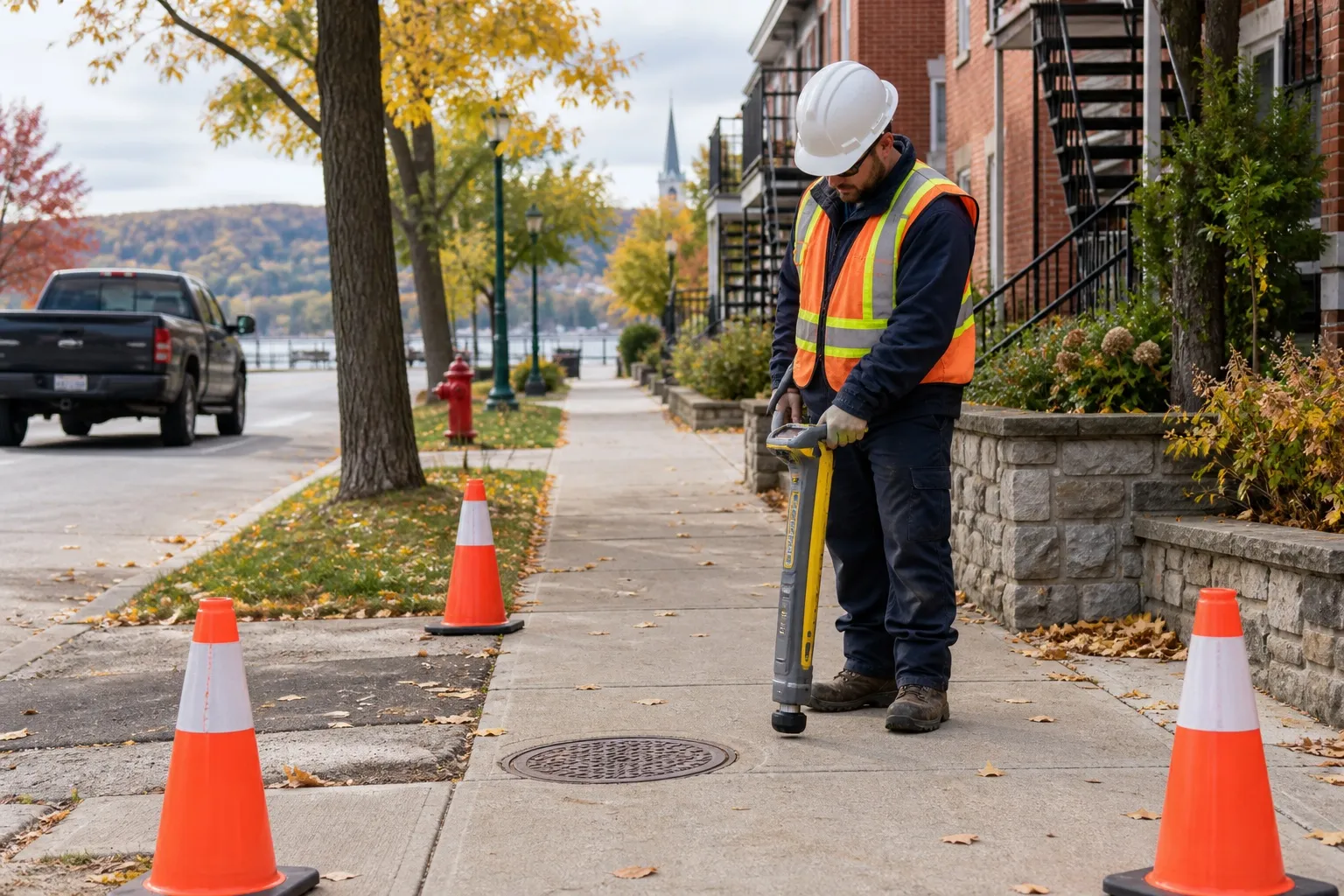
These utilities do not appear in any database. Only on-site locating reveals them. A ground penetrating radar survey combined with electromagnetic locating can detect metallic pipes as well as plastic or concrete pipes, then mark their position and estimated depth on the ground.
- the water service line and the weeping tile around the foundation;
- landscape lighting, outdoor outlets and wiring to a shed;
- power to a pool or spa pump;
- an old oil tank or a decommissioned well.
Local considerations in central neighbourhoods and Montreal's subsurface
Old Montreal, downtown and the commercial arteries combine several challenges: a saturated subsurface, thick concrete slabs and restricted access. Before any core drilling or drilling into a structure, concrete scanning before core drilling avoids hitting an electrical conduit, a post-tension cable or a pipe embedded in the slab.
In older residential areas, the problem comes instead from successive modifications: additions, renovations and connections made over the decades without reliable documentation. Every property tells a different story beneath the surface.
The lesson applies to the whole island: the denser the urban fabric, the more locating becomes insurance against costly strikes. The official request lays the foundation, and the private survey completes the picture where it stops.
Conclusion
In Montreal, the exceptional density of infrastructure makes the Info-Excavation Montreal process a non-negotiable step, but rarely sufficient on its own. It secures public utilities up to the property line, while private installations, invisible to members, require dedicated locating. Before the first shovelful, combine the official request with a complete subsurface survey to protect your job site, your budget and your schedule.
Frequently asked questions
What exactly is Info-Excavation Montreal?
Info-Excavation Montreal is the free request that notifies member owners of public utilities before your work. Once it is submitted, these owners locate and mark their lines up to your property line. However, the service does not cover private installations buried on the property, such as landscape lighting or a line to a shed, which require separate locating. This step remains the foundation of a safe job site.
How long before digging should the request be made?
The Régie du bâtiment recommends submitting your locate request at least four business days before work begins. This lead time gives utility owners time to locate and mark their infrastructure. The request then remains valid for up to one hundred and eighty days, which covers most residential and commercial projects planned in advance on the island. It is better to allow plenty of time.
Does Info-Excavation detect private utilities on my property?
No, the public process stops at your property line. Cables, pipes and tanks installed by previous owners or during private landscaping do not appear in any member database. Weeping tile, a pool pump or an old buried tank remain invisible to this service. Private locating using ground penetrating radar and electromagnetic locating then becomes necessary to map these elements before digging.
Is there a fee for the locate request?
No, the locate request with the organization is entirely free and available at any time, day and night. You pay nothing for member owners to come and mark their public utilities. Costs arise only if you choose additional private locating for installations on your property, a modest investment compared with the cost of a broken pipe or cable.
Why add private locating to the public markings?
Because public markings show only part of the picture. In densely built areas, a single strike can interrupt a service, injure a worker and lead to costly repairs. Combining the official process with a private survey provides a complete view of the subsurface, from municipal utilities to small residential installations. This extra caution protects your schedule, your budget and above all the safety of the crews on site.