Before digging in Quebec, first make a locate request to Info-Excavation for public utilities up to the property line. The private lines on your property, such as the water service line, the drain or the cable to the garage, are not covered and require specialized locating.
A fence project, an in-ground pool or simple landscaping: every shovelful before digging in Quebec can cross a buried utility. Many property owners believe a single step is enough to locate everything. The reality is more nuanced, and this confusion is behind many costly and dangerous strikes.
Understanding where Info-Excavation's responsibility ends and yours begins changes everything. It is the difference between a job site that moves forward safely and a water service line severed on a Friday afternoon.
What Info-Excavation covers and what it does not
Info-Excavation is the only damage prevention organization in Quebec. By submitting a free locate request to Info-Excavation, you automatically notify the member utility owners present in your work area.
These owners, including Hydro-Québec, Énergir and Bell, then confirm the location of their installations. The crucial point fits in one sentence: this process covers public utilities, not what belongs to your property.
Public utilities up to the property line
The locating offered by the organization stops at your property line. It targets the major infrastructure crossing public land: natural gas, electricity, telecommunications and, depending on the municipality, street water mains and sewers.
This step is unavoidable. The Régie du bâtiment du Québec outlines the obligations related to excavation work and considers it essential to find out about buried installations before any job, even a modest one.
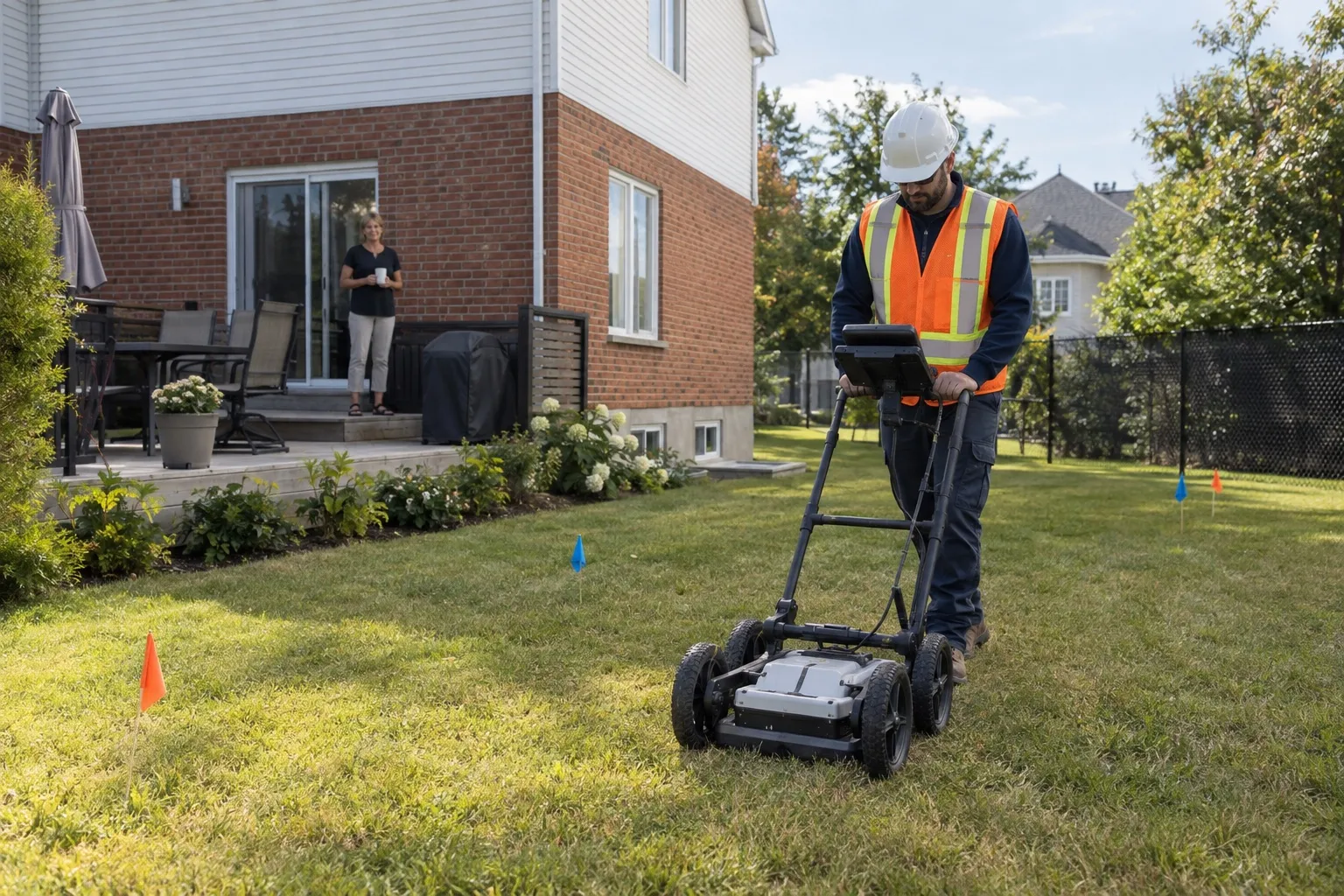
Why your private lines are not covered by the request
Once past the property line, no one comes to mark the ground anymore. The service connections and utilities you had installed on the property are your responsibility. They do not appear on any plan from Info-Excavation members.
That is exactly where unpleasant surprises happen. The cable powering the detached garage or the pool pump will never be located by the free request.
Which private lines to have located on your property
On a residential or commercial property, several private utilities are hidden under a few centimetres of soil. Here are the ones a specialized service can locate your underground pipes for before work:
Each of these elements can be severed in seconds by an excavator. A simple power cable locating service avoids electrocution, flooding and a job site shutdown.
- The water service line connecting the street to the building
- The power cable to a garage, shed, pool or lamppost
- The weeping tile, private sewer and drainage pipes
- The gas line to a built-in barbecue or patio heater
- Landscape lighting, the irrigation system and tracer wires
- Abandoned pipes forgotten during earlier work
Steps to follow before digging in Quebec
The right method combines several checks that do not replace one another. Here is who does what.
Public utilities (Info-Excavation): locating is done by the member utility owners, up to the property line, free of charge. Examples: gas, electricity, telecom, street water main.
Private lines (your property): locating is done by a private underground locating service, across the entire property; it is a specialized service. Examples: water service line, drain, cable to a garage or pool, lighting.
In practice, your action plan goes like this:
1. Submit the locate request to Info-Excavation several days in advance
2. Wait for a response from all the owners concerned before starting
3. Have your private lines located by a specialized team
4. Check the municipal permit if your work affects public land
5. Dig carefully near the marked routes, by hand or by hydro-excavation
Are you planning a job soon and unsure what runs under your property? Have your private utilities assessed by professionals before taking out the shovel: a few hours of locating protects against months of damage.
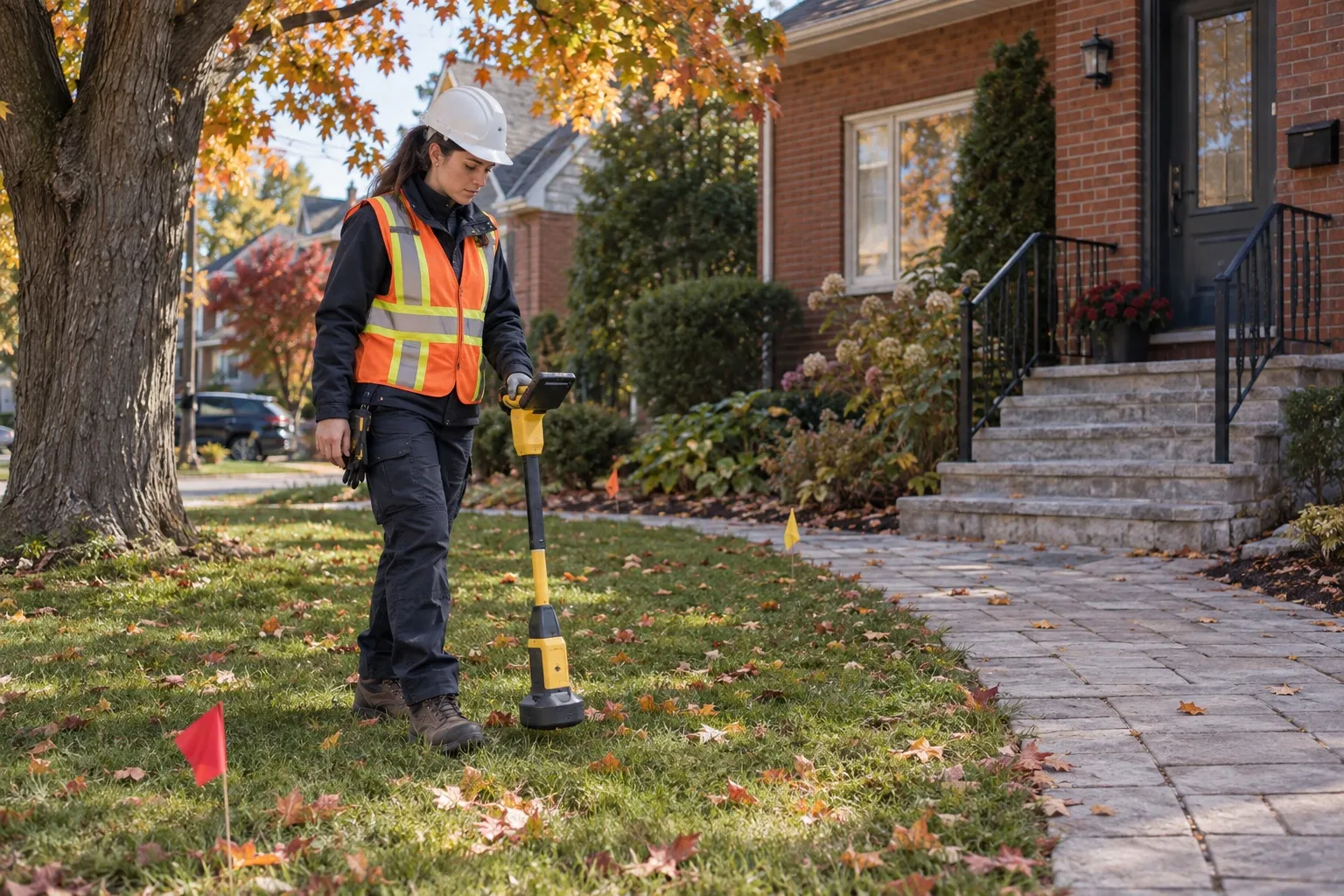
How a private service locates buried lines
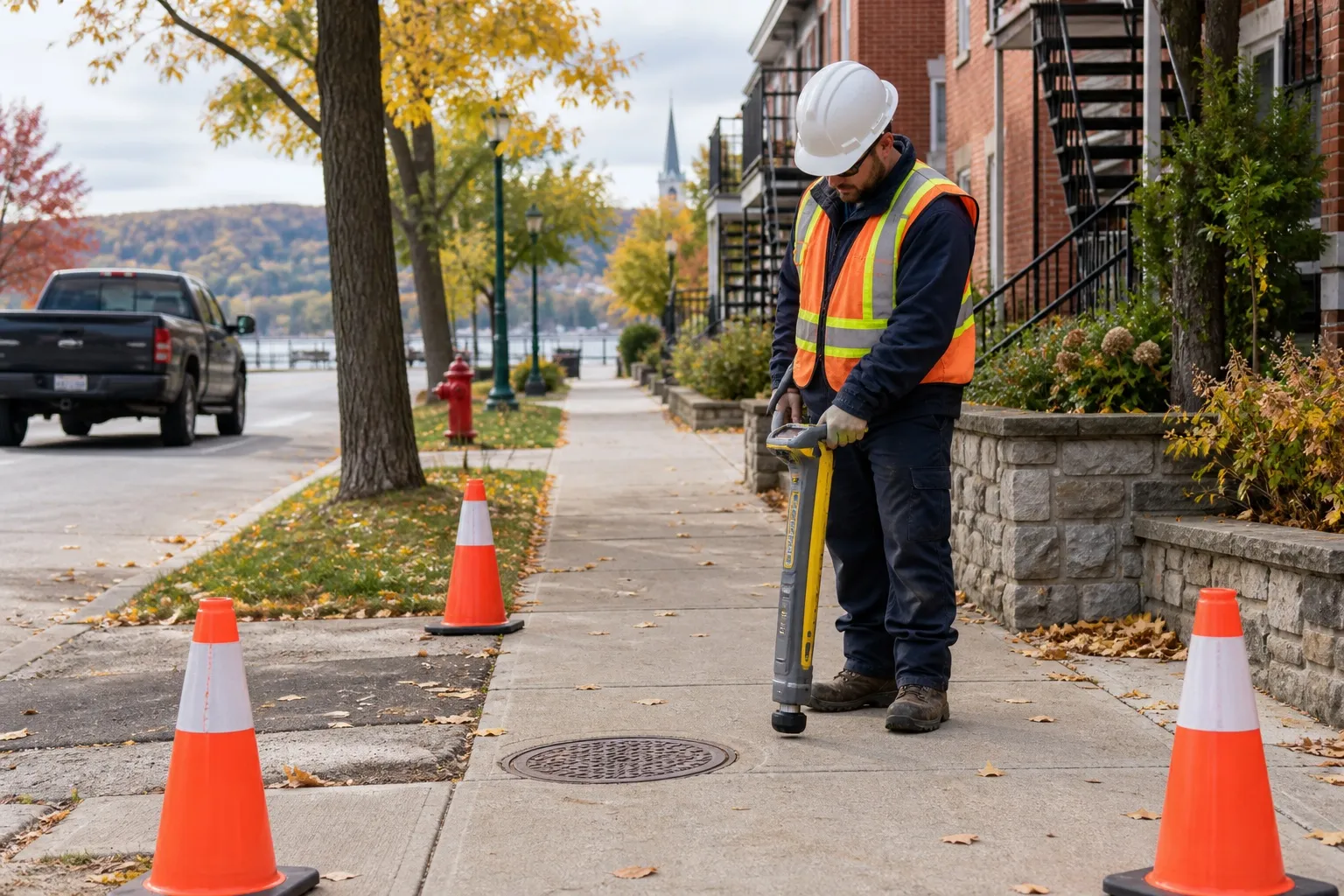
Locating is not guesswork. It relies on complementary instruments, chosen according to the material of the line being located. Ground penetrating radar technology and electromagnetic locating form the basic pair.
Electromagnetic locating injects a signal into a metallic conduit or a tracer wire, then follows that signal at the surface with a receiver. GSSI ground penetrating radar, for its part, reveals non-metallic materials such as PVC, polyethylene or concrete, as well as some voids.
The result takes a concrete, documented form:
This deliverable becomes your reference on the job site and written proof that locating was carried out, as good excavation practices require.
- Ground markings using a standardized colour code
- Estimated depths indicated at each marker
- A plan and a PDF report delivered promptly after the visit
Municipal permit and careful excavation near the routes
Locating is not always enough. If your project affects public land or comes close to it, a permit may be required. The City of Montreal explains when an excavation permit is required, notably depending on the depth of the work and its distance from public land.
Once everything is marked, caution is still in order. Never assume the exact depth of a line. Right next to the routes, hand digging or hydro-excavation remains the safest way to expose without puncturing.
This rigour applies everywhere, whether you are working downtown or in the suburbs. Whatever the service area in Greater Montreal, the logic is the same: locate, mark, then dig slowly. It is the reflex that separates a controlled job site from a preventable accident, and it should guide every decision before digging in Quebec.
Conclusion
Before digging in Quebec, remember the golden rule: Info-Excavation handles public utilities up to the property line, and you remain responsible for the private lines on your property. Combining the free request, specialized locating, the municipal permit and careful excavation eliminates nearly all risk of strikes. Before your next project, take the time to have what lies beneath your feet mapped: a professional assessment turns uncertainty into a clear, safe plan.
Frequently asked questions
What should you do before digging in Quebec?
Before digging in Quebec, submit a free locate request to Info-Excavation for public utilities present up to your property line. Then wait for a response from all the owners concerned before starting. Also have your private lines located by a specialized service, then dig carefully near the marked routes, ideally by hand or by hydro-excavation, to avoid any costly and dangerous strike.
Does Info-Excavation locate private lines?
No. The request to Info-Excavation targets its members' infrastructure, such as gas, electricity and telecommunications, located up to your property line only. The service connections and utilities that belong to you, for example the water service line, the drain, the cable to a garage or landscape lighting, are marked by no one. A private underground locating service then becomes essential to locate them precisely on your property.
How much time should you allow before work begins?
Allow enough time: after your request, member utility owners have a few business days to confirm their installations. You must wait for all responses before starting excavation. Plan your request several days in advance, especially during construction season, when lead times get longer. Use this time to arrange the locating of your private lines, so that everything is marked when it is time to dig.
Do you need a municipal permit to dig?
Often, yes. As soon as your work affects public land or comes close to it, the municipality generally requires an excavation permit. In Montreal, for example, a shallow excavation close to the public boundary may be covered. Check your borough's requirements before the first shovelful. This permit is in addition to the locate request and the locating of your private utilities, without replacing them.