Locating underground pipes involves finding and marking buried utilities (water, gas, electricity, telecom, drainage) on the ground before digging. Carried out with ground penetrating radar and electromagnetic locating, it reduces the risk of strikes, protects workers and complements the free request made to Info-Excavation.
An excavator bucket in the wrong place can cut power to a neighbourhood, cause a gas leak or drive up a repair bill in seconds. Locating underground pipes is meant precisely to avoid this scenario by mapping what lies beneath your feet. Whether you are preparing a foundation, an in-ground pool, a fence or a connection, knowing where buried utilities run changes everything for safety and for the schedule.
This guide explains when to do a survey, what the public service covers, what it leaves out, and which technologies make it possible to see underground without digging.
Why locate underground pipes before digging
Quebec's subsurface is dense: water mains, sewers, natural gas, electricity, telecommunications and fibre optics often cross at shallow depths. A simple snag can cause a service interruption, an electrical hazard or a dangerous leak.
Beyond the immediate danger, there is a question of liability. Under the RBQ's obligations regarding excavation work, the contractor must check for buried infrastructure and submit a locate request at least four business days before work begins. Damaging a utility can make you liable for the repair costs.
Rigorous locating brings concrete benefits:
- Lower risk of strikes, injuries and job site shutdowns
- A more reliable schedule, with no surprises during excavation
- A solid basis for designing and laying out your structures
- Protection of your liability in the event of a dispute
Info-Excavation covers public utilities up to the property line
The first essential step: the request to Info-Excavation. By filling out the free locate request form, you notify the member owners present in your area, such as gas, electricity and telecommunications providers.
These members then come to mark the location of their utilities, or send a report with a sketch. The service is free, fast and should be part of every project, from the smallest landscaping job to a major construction site.
There is, however, an important limit to understand. Info-Excavation locates its members' infrastructure up to your property line. Whatever is inside your property falls outside this scope.
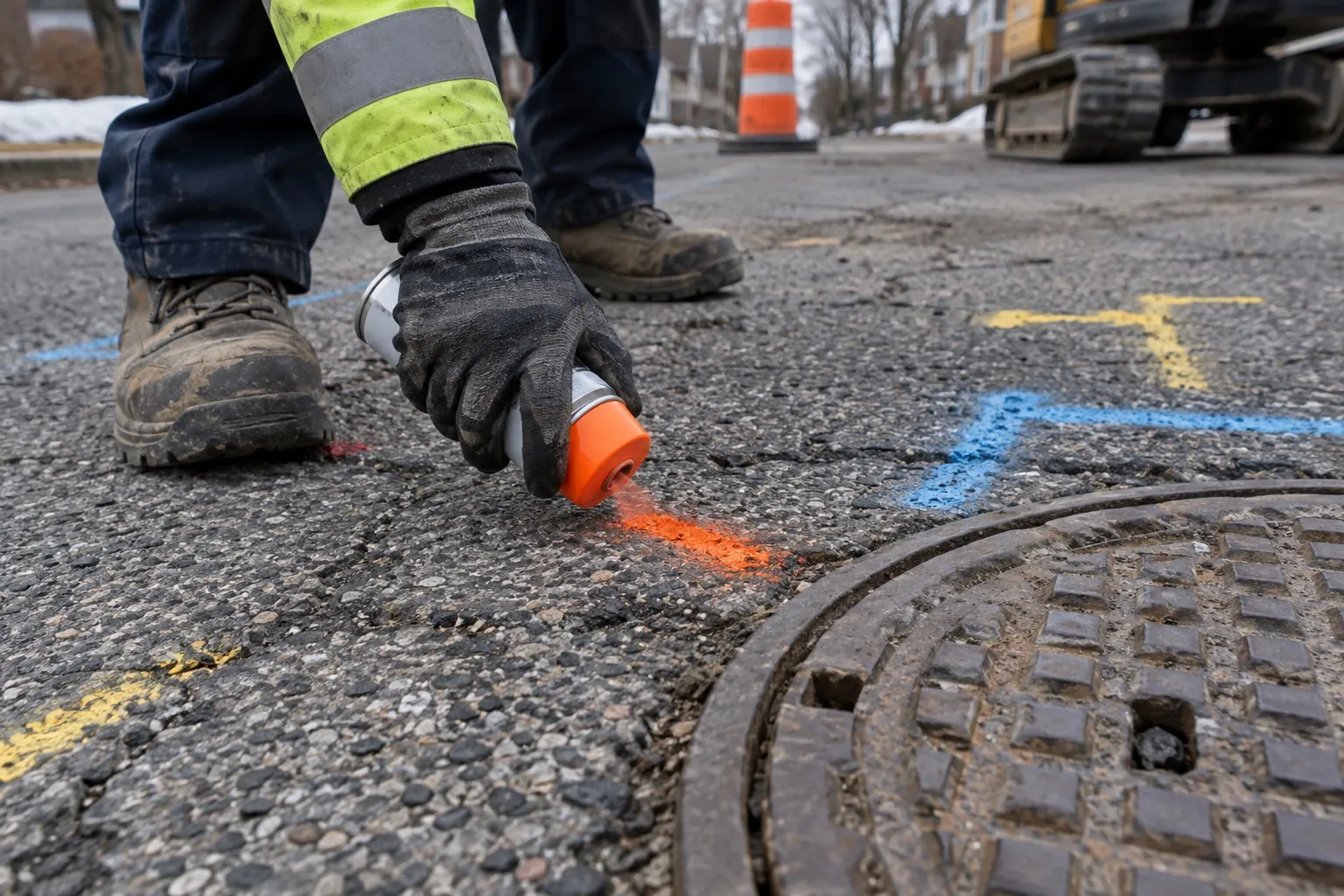
Private utilities the public service does not cover
That is where a specialized survey takes over. On a property, many installations belong to the owner and are not covered by the public service. They must be located by a private firm before excavation.
Common private utilities include:
A private pipe locating service makes it possible to map these elements precisely. For supply lines, buried water line locating and buried power cable locating complete the picture before any digging.
Are you planning work and want to avoid unpleasant surprises under your property? It is wise to schedule a survey before your work at the design stage.
- Power cables to a shed, detached garage or lamppost
- Landscape lighting, pool or spa lines
- Power to a well, foundation drain or septic tank
- Water service connections and gas lines after the meter
Locating methods used before digging
No single technology sees everything. A reliable survey combines several approaches depending on the nature of the buried materials. Metallic and non-metallic utilities do not respond to instruments in the same way.
Electromagnetic locating
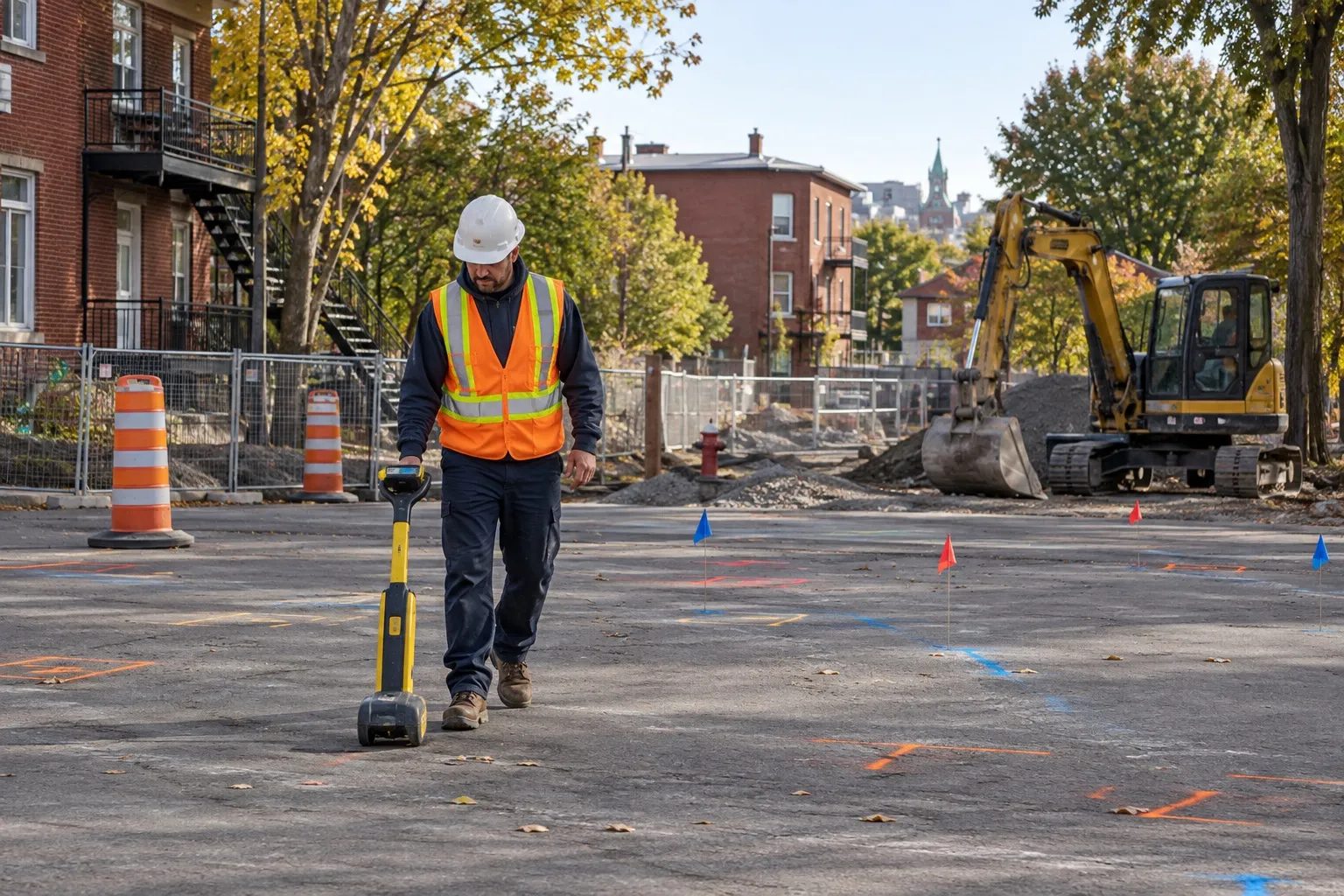
This method injects a signal into a metallic pipe or a tracer wire, then a receiver follows that signal at the surface to trace the route. It is effective for cables, steel pipes and gas lines fitted with a tracer wire. A transmitting sonde can also be inserted into a drain or an empty conduit to follow it.
GPR ground penetrating radar
A GPR ground penetrating radar survey sends waves into the ground and reads the echoes returned by buried objects. It excels where electromagnetic locating reaches its limits: PVC and polyethylene pipes, concrete pipes, voids and old structures. Combining the two methods provides much more complete coverage.
Preferred method by utility, with common materials in parentheses:
- Electrical (steel, PVC): electromagnetic locating or ground penetrating radar
- Telecom and fibre (PVC, HDPE): sonde or ground penetrating radar
- Gas (steel, polyethylene): electromagnetic locating on a tracer wire
- Drainage and sewer (PVC, concrete, cast iron): sonde or ground penetrating radar
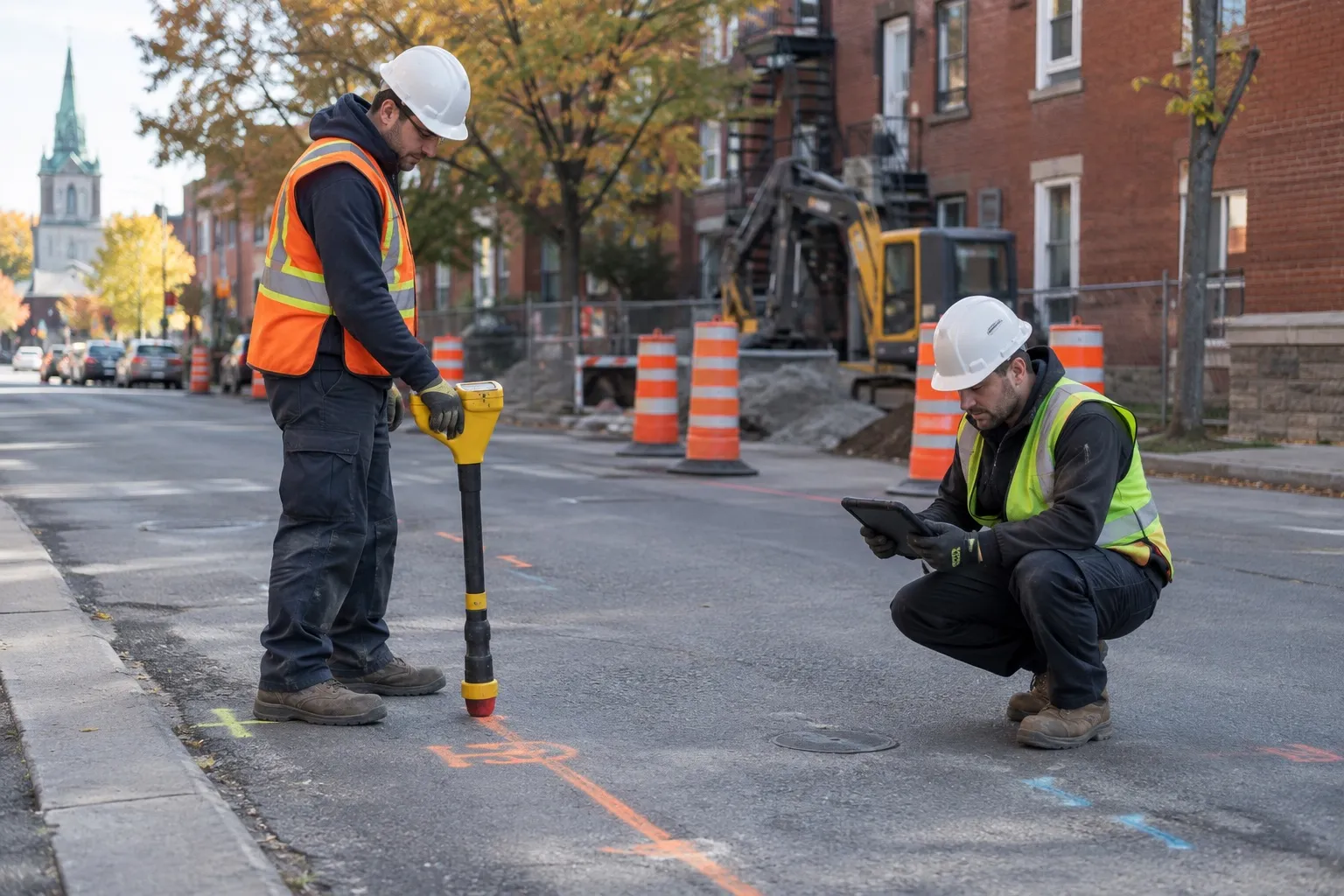
What a professional survey includes
A good survey is not limited to a few lines of paint. It leaves you with a clear deliverable, useful on the job site as well as at the design stage.
These elements make coordination easier between the excavator, the engineer and the project owner. They also serve as a reference if a question arises later about the location of a utility.
- Ground markings of the routes according to the utility colour code
- Estimated depths at each identified marker
- A plan and PDF report bringing together the routes and observations
- Recommendations for excavating safely
Steps to follow before starting work
A well-prepared project follows a logical sequence. Here is the recommended order for a job site in Quebec, from a single-family home to a commercial project.
1. Submit a free request to Info-Excavation, several business days in advance
2. Wait for the markings or report from all the member owners concerned
3. Have a private survey carried out for utilities located inside the property
4. Respect the buffer zones around the located infrastructure
5. Excavate with care, keeping the plan and markings close at hand
This approach applies throughout the service areas of Greater Montreal, from the North Shore suburbs to the South Shore.
Conclusion
Locating underground pipes is not a formality: it is the assurance of a safe, compliant job site with no unpleasant surprises. By combining the free request to Info-Excavation for public utilities with a private survey for everything on your property, you cover all buried installations before digging. Take the time to have the subsurface mapped at the planning stage, and you will avoid costly repairs and preventable delays.
Frequently asked questions
What is underground pipe locating?
Locating underground pipes is the process of finding, tracing and marking buried utilities on the ground before an excavation. It combines ground penetrating radar and electromagnetic locating to map water, gas, electricity, telecommunications and drainage. The result includes markings, estimated depths and a plan, which makes it possible to dig while significantly reducing the risk of strikes and accidents.
Is Info-Excavation enough before digging?
Info-Excavation is essential, but rarely sufficient on its own. The free service notifies member owners, who mark their public utilities up to the property line. However, it does not cover private installations inside the property, such as a cable to a shed, a drain or a pool line. An additional private survey remains necessary for these elements before work begins.
How deep can the instruments detect?
The detectable depth varies depending on the soil, the utility material and the method used. Electromagnetic locating effectively follows metallic pipes and tracer wires, while ground penetrating radar also detects PVC, polyethylene and concrete. Site conditions, such as wet clay soil, affect the range. A technician adjusts the equipment on site and indicates the estimated depths at each marker in the survey.
How long before work should you plan?
You need to plan ahead. Regulations require submitting the locate request at least four business days before work begins, to give members time to respond. For a private survey, it is best to book at the design stage so the results can be incorporated into the plans. Planning ahead avoids job site shutdowns and leaves time to adjust the layout of structures if a utility lies on the planned route.